BRAZIL
Brazil is one of the world's surfing powers. However, it does not have specific regulations to protect surf breaks and its marine and coastal spatial planning processes are still developing.
Currently, waves are being protected indirectly only within the natural protected areas of the National System of Conservation Units.
One of the main achievements has been the federal management plan for the Baleia Franca Environmental Protection Area. This recognizes the existence of the Guarda do Embaú World Surfing Reserve, and incorporates actions aimend at preserving the breakers and the adjacent evironment.

BRAZIL
1/
GENERAL RULES FOR THE PROTECTION OF SURF BREAKS
In Brazil, there are no regulations directly related to the protection of surf breaks, but general environmental protection laws can be invoked for their defense, which derive from its Constitución. The Constitution also provides certain constitutional remedies that can be invoked for wave protection, such as an individual or collective habeas corpus (which could be used to defend public access to beaches and surf breaks), and the popular action (which could also be applied to defend rights of access to public property).
Certain actors and non-governmental organizations, such as the NGO Ecosurf, submitted a request to the Chamber of Deputies to establish "protected surfing areas" within the National Policy for the Conservation and Sustainable Use of the Brazilian Marine Biome. This petition results from mobilization by the surfing community and civil society proposing that surf breaks become part of the country's public policies. However, this has not yet been achieved.
2/
SURF BREAKS AND PROTECTED AREAS
Law 9958 of 2000 established the National System of Conservation Units, whose main objective is biodiversity conservation through the creation of protected areas. Within the different categories of conservation units that comprise the national system, the categories of national marine park (as total protection units) or environmental protection areas (as sustainable use units) could be used for surf break protection.
To date, Brazil has 63 marine protected areas, of which 24 are total protection areas and 39 are sustainable use areas. Within this framework, there are various conservation units that include waves, such as Itamambuca Beach, Praia Branca and Praia do Tombo, Prainha, Saquarema Beach and Frances Beach.
The aforementioned conservation units are not specifically aimed at protecting surf breaks. However, organizations are promoting the creation of surfing reserves as a new category of conservation unit, which has not yet materialized.
2.1. GUARDA DO EMBAÚ SURFING RESERVE
Brazil has Guarda do Embaú, a World Surfing Reserve, certified by the Save The Waves Coalition, located in Santa Catarina state. It is situated within several conservation units: the Serra do Tabuleiro State Park, which protects the Atlantic Forest biome, and the Baleia Franca Environmental Protection Area. Additionally, the Environmental Protection Area Entorno Costeiro has the Madre River as its primary environmental resource, which, among its various environmental functions, is essential for the sedimentation processes that shape the sandbanks where waves break.
The federal management plan for the Baleia Franca Environmental Protection Area officially recognized the World Surfing Reserve. The reserve is managed by the Guarda do Embaú Surf and Preservation Association with support from the local community and government. This association has focused on promoting the restoration of the Madre River basin through improved rice cultivation practices, better sewage systems, and urban planning.
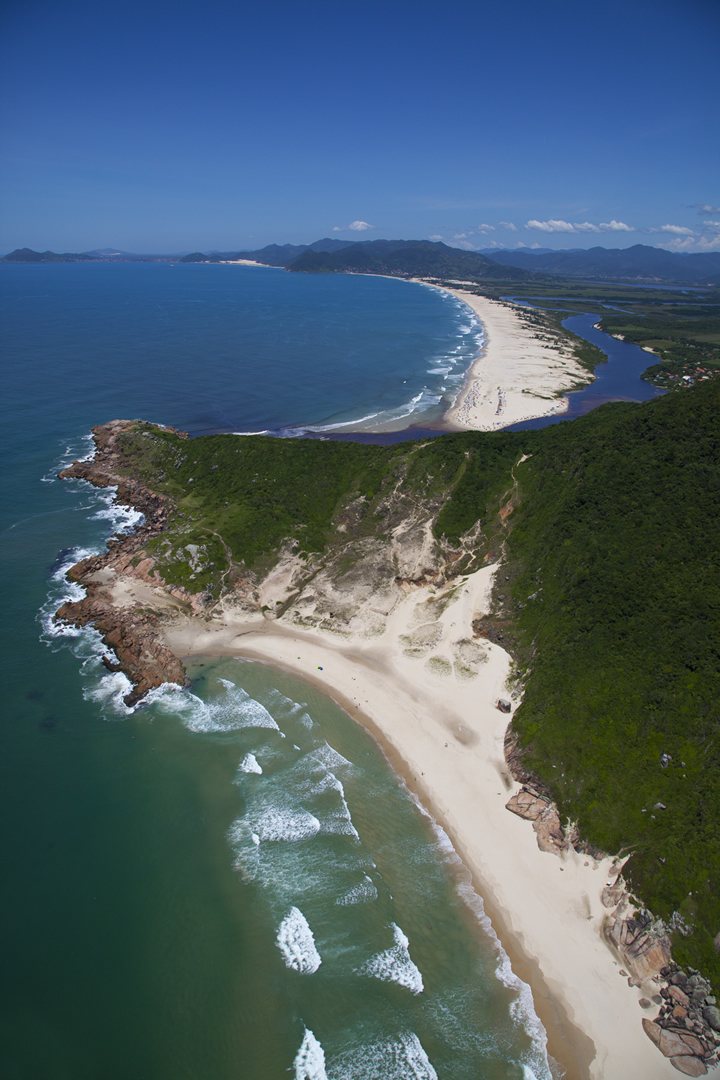
Within the Serra do Tabuleiro State Park, the Guarda do Embaú World Surfing Reserve promotes a collaborative governance model for environmental protection.
3/
DEVELOPMENTS IN MARINE-COASTAL ZONE MANAGEMENT PLANS
Brazil does not have a single competent authority for coastal zone management or for developing legislation and public policies related to recreational use and/or protection of surf breaks. The federative entities (Union, states, and municipalities) may or may not act jointly.
Nevertheless, the Brazilian Navy is in the process of taking the first steps for a marine spatial planning based on Decree 10544 of 2020, which grants certain management competences to the Armed Forces and the Federal Police. This opens an opportunity to include the surf breaks in conversations related to marine spatial planning processes.
4/
PUBLIC ACCESS
Public access to surfing beaches is guaranteed both in the Federal Constitution of 1988 and in Law 7661 of 1988, which establishes the National Coastal Management Plan.
It is worth noting that Brazil has protected surf break areas located within military installations. This occurs, for example, with the waves in Praia do Bueno and part of Praia do Tombo, where surfing is prohibited. To date, there are no established precedents, rules, or agreements for accessing these breaks.
5/
MARINE-COASTAL POLLUTION
For the regulation, control, and sanctioning of pollution issues, general rules apply that do not specifically address surf breaks.
In Brazil, water quality control and monitoring in marine-coastal zones is carried out primarily by the Federation states.
Additionally, a Maritime Court was established as an autonomous administrative body, though dependent on the Executive branch, auxiliary to the Judiciary, and linked to the Ministry of the Navy. This court, with jurisdiction throughout the national territory, has as its main responsibilities resolving liabilities associated with accidents related to maritime, river, and lake navigation. When accidents occur, such as ship spills or pollution in areas near surf breaks, the Court can make decisions that indirectly affect their protection.
As it is a specialized, technical, and expert body in maritime issues, its decisions could serve as precedent for other judicial courts in Brazil regarding similar cases occurring at sea, including shipping accidents.
To date, there are no Maritime Court rulings specifically related to wave protection.